
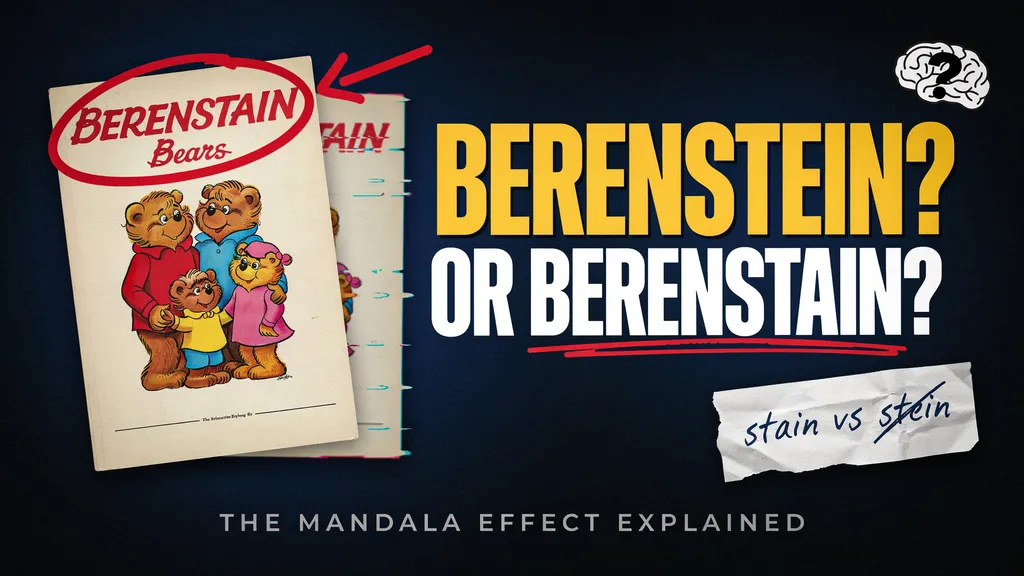
Have you ever looked at an old book from your childhood and felt like your whole memory was a lie? That exact feeling hits millions of people when they explore the Berenstain Bears Mandela Effect. For decades, families grew up reading cheerful stories about Mama, Papa, Brother, and Sister Bear. Many people vividly remember reading the family name spelled with an “e” as “Berenstein”. However, looking at an original printed cover reveals the true spelling ended in “stain”. This startling gap between personal memory and printed truth creates an instant shock. It leaves readers wondering if their minds are tricking them or if reality itself shifted.
Understanding the berenstain bears mandela effect helps us learn how human memory forms, stores, and rewrites information over time. When thousands of people share the exact same wrong memory, it creates a fascinating mystery. Some people blame alternate realities, while scientists point to how our brains process language and daily patterns. In this complete guide, we will unpack the history, dive into cognitive science, and look at real historical facts. By exploring every angle of this pop culture phenomenon, you will see why a simple spelling disagreement continues to captivate the internet and spark friendly debates around the world.
What Is the Berenstain Bears Mandela Effect?
The berenstain bears mandela effect refers to a widespread belief that the classic book series was once spelled with an “e” as “Berenstein”. A Mandela Effect happens when a large group of people shares a collective false memory about a famous event or brand. In this case, people swear they recall reading “Berenstein” on book covers, TV show titles, and childhood VHS tapes. Yet, historical records prove the title has always been spelled “Berenstain” with an “a”. This stark difference between memory and reality turns a simple spelling error into a massive online mystery that puzzles readers everywhere.
How the Berenstain Bears Mandela Effect Started
Internet discussions about the berenstain bears mandela effect took off on forums like Reddit and community blogs in the early 2010s. The term “Mandela Effect” was originally created in 2010 by researcher Fiona Broome. She noticed that thousands of people falsely remembered Nelson Mandela dying in prison during the 1980s. When people started sharing other strange collective memories online, the bear family quickly became the star example. Someone posted about their childhood memory of the “e” spelling, and thousands of commenters chimed in to agree. This created a giant wave of shared nostalgia and online intrigue.
Berenstain vs Berenstein: Why Our Minds Play Tricks
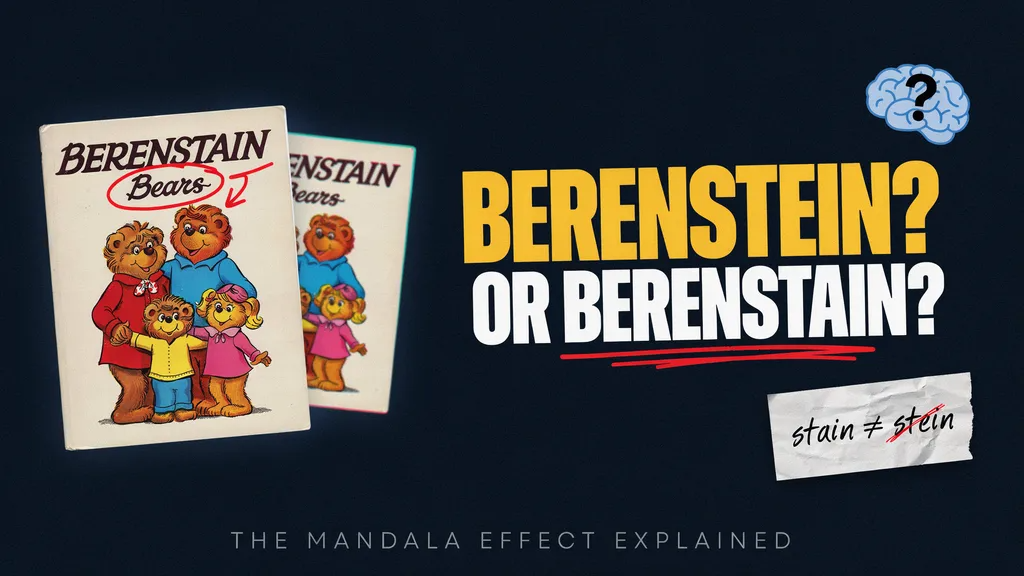
When we look closely at the berenstain bears mandela effect, phonetics plays a huge role in how our brains process words. In the English language, last names ending in “stein” are extremely common, such as Einstein or Frankenstein. On the other hand, last names ending in “stain” are quite rare. Because of this, our brains naturally expect the familiar “stein” ending whenever we read or hear the name. Furthermore, when adults read children’s books out loud, they often pronounced the name as “Beren-steen” or “Beren-stine”. This spoken habit reinforced the wrong spelling in young minds for many years.
The Science Behind False Memories and Schemas
Psychologists study the berenstain bears mandela effect to understand how human memory works and why it fails. Our brains do not work like video cameras that record exact events. Instead, the brain relies on mental shortcuts called schemas to fill in missing details. Famous memory researcher Elizabeth Loftus showed that human memory is flexible and easily influenced by suggestion. When you see a word that looks almost like a common pattern, your brain automatically fills in what it expects to see. Over time, that reconstructed image becomes your official, solid memory without you ever realizing the original swap.
Are Parallel Universes Behind the Berenstain Bears Mandela Effect?
Sci-fi fans love talking about the berenstain bears mandela effect because it sounds like a plot from a fantasy movie. A popular internet theory suggests that we are living in a multiverse with infinite parallel timelines. Proponents argue that a dimensional shift occurred, merging two realities together. In the original timeline, the family was spelled “Berenstein,” but after a shift, we landed in the “Berenstain” reality. Some internet users even playfully blame experiments at particle physics labs like CERN for altering human history. While scientists dismiss these claims, the parallel universe theory remains a super fun topic to debate online.
The Real History of Stan and Jan Berenstain
To truly unpack the berenstain bears mandela effect, we have to look at the authors themselves and their real family history. Stan and Jan Berenstain created the beloved bear family back in 1962 with their first book, The Big Honey Hunt. The famous publisher Dr. Seuss, whose real name was Ted Geisel, actually named the book series after the couple. Stan Berenstain explained in his autobiography that his family name was frequently misspelled his whole life. His elementary school teachers even tried to correct his name to “Bernstein”. This proves the spelling confusion existed long before the internet ever invented conspiracy theories.
Other Famous Mandela Effect Examples in Pop Culture
The berenstain bears mandela effect is not the only case of shared false memory in modern pop culture. Millions of movie fans remember Darth Vader saying, “Luke, I am your father,” but the real line is “No, I am your father”. In Snow White, many people recall the Evil Queen saying “Mirror, mirror on the wall,” when she actually says “Magic mirror on the wall”. People also misremember the Monopoly Man wearing a monocle or the KitKat logo having a hyphen. These shared mix-ups show that human memory frequently invents subtle details across books, movies, and famous commercial logos.
Why the Berenstain Bears Mandela Effect Captivates the Internet
The explosion of social media made the berenstain bears mandela effect a giant viral sensation that refuses to fade away. It combines cozy childhood nostalgia with a spooky, mind-bending mystery that anyone can test in five seconds. When people check their dusty attic book piles and see “stain,” it creates a shocking moment of self-doubt. People love sharing that feeling of surprise with friends and family on TikTok, YouTube, and forums. It sparks immediate conversation because it touches something deep inside our memories that we felt totally certain about since early childhood.
How Children Learn Language and Spelling Patterns
Looking at childhood reading habits gives us fresh clues about the berenstain bears mandela effect and early learning. When young kids learn to read, they do not look at every single letter in a word. Instead, kids recognize words by overall shape, beginning letters, and familiar sounds. Since the cursive handwriting font on the book covers was stylized, the letter “a” easily looked like an “e” to young eyes. Parents reading bedtime stories also glanced quickly at the cover, assuming the standard “stein” ending. This created a double layer of misreading for both children and parents alike.
Can We Ever Really Trust Our Childhood Memories?
Reflecting on the berenstain bears mandela effect reminds us that our childhood memories are far more fragile than we think. We often hold onto childhood recollections with deep emotional confidence. However, science proves that every time we recall a memory, our brain slightly rebuilds it. Mishearing a word once or hearing a friend mispronounce a title can permanently alter how we store that memory. Rather than feeling worried, we can view this as a fascinating lesson about human nature. Our minds favor efficiency and storytelling over strict, flawless detail recording every single day.
Comparison: Real History vs. Collective Misremembering
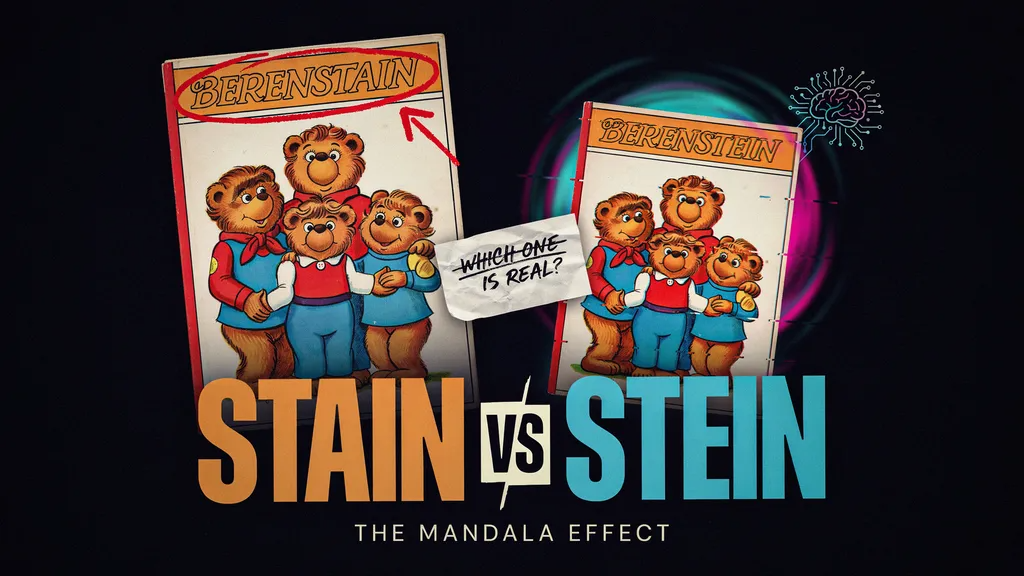
To help organize all these facts, here is a detailed breakdown of the berenstain bears mandela effect vs real historical evidence:
| Aspect | The Common Memory (“Berenstein”) | Historical Fact (“Berenstain”) |
| Spelling | Ends with an “e” (-stein) | Ends with an “a” (-stain) |
| Origin | Childhood recollection and vocal pronunciation | Ukrainian-Jewish heritage of the authors |
| TV Shows & Media | Remembered as Berenstein Bears | Copyrights and credits always said Berenstain |
| Scientific Cause | Dimensional shift or parallel universe | Cognitive schema and phonetic auto-correction |
| Publisher Influence | Supposed stealth edit of book titles | Named by Dr. Seuss (Ted Geisel) in 1964 |
Frequently Asked Questions
Why do so many people fall for the berenstain bears mandela effect?
Most people fall for it because “-stein” is a far more common ending for last names in English. The brain automatically fills in the expected pattern when reading quickly.
Who originally came up with the term Mandela Effect?
The term was created in 2010 by researcher Fiona Broome after discovering that thousands of people falsely remembered Nelson Mandela dying in prison during the 1980s.
Did the spelling in the berenstain bears mandela effect ever actually change?
No, published books, official copyrights, and animated television credits have always used the spelling “Berenstain” since the series debuted in 1962.
What did author Stan Berenstain say about his last name?
Stan Berenstain noted in his autobiography that people constantly misspelled his name as “Bernstein” his whole life, starting with his elementary school teachers.
Is there scientific proof of parallel universes causing false memories?
No, there is no scientific evidence supporting parallel universes for memory gaps. Cognitive scientists explain these occurrences through memory reconstruction and psychological biases.
How can I check if I have a Mandela Effect memory?
Look up famous quotes or logos you feel 100% sure about—such as the Monopoly Man’s monocle or Darth Vader’s line—and compare your recollection to verified historical archives.
Conclusion
Exploring the berenstain bears mandela effect is a wild journey through memory, language, and internet culture. It shows us that even our strongest memories can be tricked by simple spelling patterns and mental shortcuts. Whether you prefer scientific explanations or love sci-fi multiverse theories, this mystery connects millions of readers worldwide. What about you? Did you grow up believing it was spelled with an “e” or an “a”? Share your childhood memories and join the discussion with friends today!
